The challenge: Indy Hall's 20th anniversary party was coming, and we needed to go big for the occasion. And an essential component of every major celebratory gathering is, needless to say, lighting.
It just so happens that I know a thing or three about lighting design. I've done it professionally before! Never anything on a massive scale, to be fair, but enough to know my way around DMX512, consoles, fixtures, programming, et cetera. I knew that a celebration of this scale could make good use of this skillset (and was excited at the all-too-rare opportunity to actually use it), so I volunteered my services from the very beginning of the planning process. As the planning progressed, it quickly became evident that this was an opportunity to not only give the party the best vibes possible, but to make permanent upgrades to the clubhouse and enable us to go "dark mode" anytime we wanted.
Naturally, it wasn't long before several unique challenges presented themselves.
- The budget was generally limited to donations received for the party
- Anything hard-wired was largely out of the question; we had to rely on some sort of wireless tech for inter-device communication
- The space is constantly shifting between regular day-to-day coworking and events of every imaginable size and configuration, so everything had to stay out of the way or be very easy to move
The original plan was to use a wireless DMX512 solution (DMX512 is a protocol for telling lighting fixtures what to do, which I'll elaborate on shortly), but this would have taken up a large chunk of the budget that could be spent on actual lighting, and the technology was prone to occasional dropouts. When lights stop receiving a DMX signal, they tend to revert to some undesirable behavior like going dark or doing some seizure-inducing automatic routine.
As such, thanks to having done lots of experimenting with DIY-type lighting control solutions in the past, I created these devices...
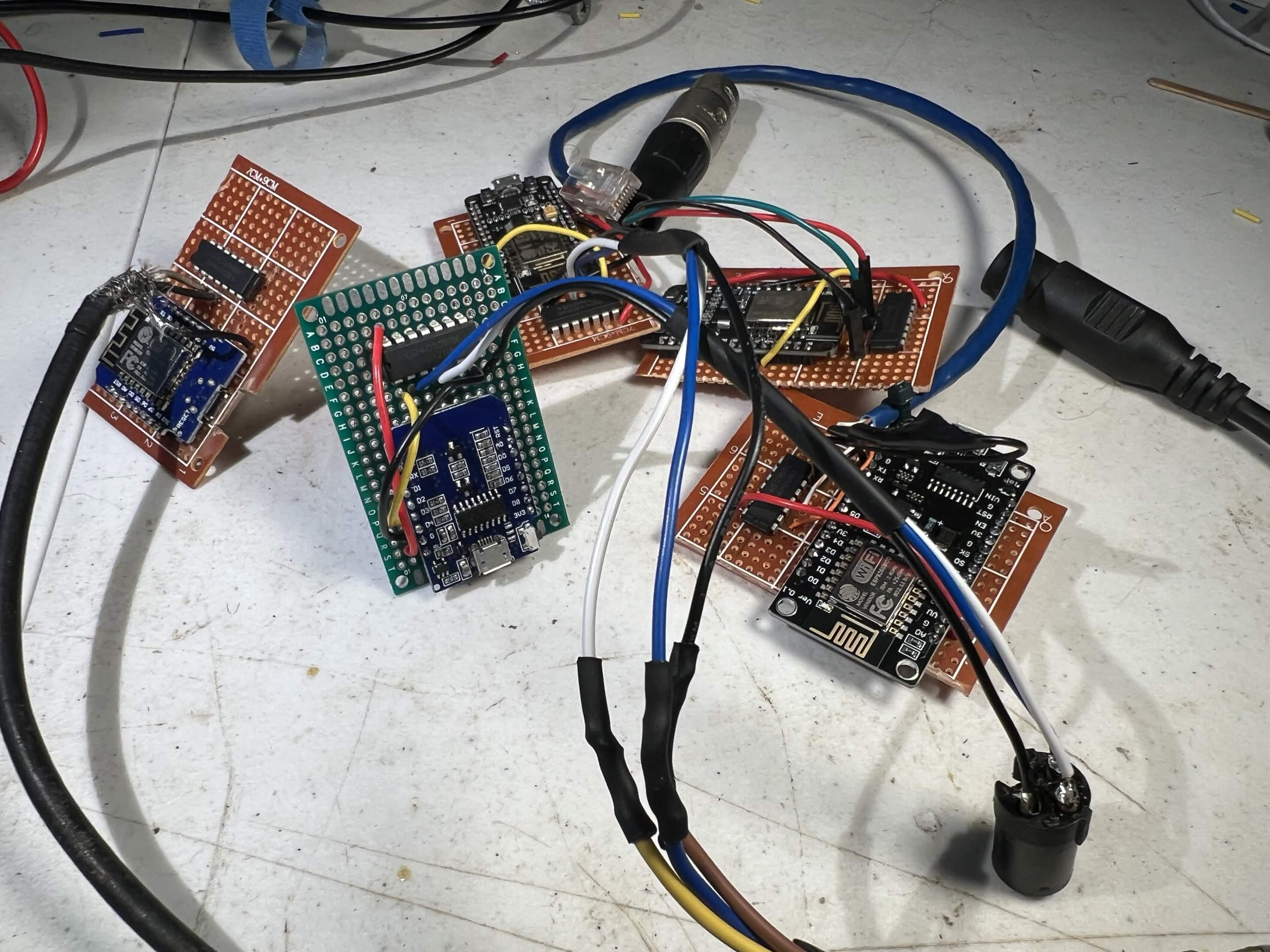
There's now about ten of these devices in semi-permanent use scattered throughout the clubhouse, each one controlling only one or two lights or sets of LED pixels. Their design is exceedingly simple; it's just an ESP8266 microcontroller and a hex Schmitt inverter chip. Let's get into how they work!
The controllers
All IH20 lighting can be divided into two categories: DMX devices, or addressable pixel chains.
DMX512
DMX512 was invented in the late 80's as a standardized, manufacturer-nonspecific way of controlling lighting instruments of all kinds. If you've ever worked with synthesizers or digital audio workstations, you can think of it as MIDI, but for lighting.
(Warning: nerdy technical details incoming! Skip ahead to the images if this isn't your jam.)
The hardware layer is RS/EIA-485, very commonly used for long-distance serial communication, which makes it a natural fit for this sort of application. On top of that is the protocol itself, which is exceedingly simple: a mark/space bit followed by 512 bytes (hence the name), each one theoretically representing the value of a single dimmer. This is then repeated approximately 44 times per second at a baud rate of 250kHz. In practice, lighting instruments have become considerably more complex since the late 80's, and lights will commonly occupy a cluster of several consecutive channels, each one representing a single property (pan, tilt, brightness, red, green, blue, etc.). Traditionally, the lighting console is the one device on the network transmitting, and everything else is receiving.
Since it's based on RS-485, the proper way to encode a signal is to use a chip intended for this purpose, such as the MAX485. I, however, elected to go a simpler route and use Schmitt inverter chips. Why?
- The ESP8266 chips operate on 3.3 volts; RS-485, however, specifies 5 volts. (I've run into issues trying to use a 3.3-volt DMX signal in the past). To use a MAX485 chip, I'd have to use a single channel of a level shifter chip, and that's one more component to solder. The Schmitt inverters automatically take care of the level conversion.
- RS-485 uses differential signaling; that is, there's a primary signal that's "normal", and a secondary signal that's a mirror image of the primary signal. By comparing the two, you get a signal that's much more resilient against interference, since any interference will (theoretically) affect both lines equally and will cancel each other out. Since these chips are inverters, I connected the serial output from the ESP8266 controller to input #1 and used that as the inverted signal, then daisy-chained that to input #2 and used that as the primary signal.
- MAX485 chips are designed to send and receive data. DMX512 is one-way (unless you get fancy with features such as RDM, which I did not), and as such, I only needed to send.
- The longest travel distance between a controller and a light is about 25 feet, with most being less than a foot. As such, I wasn't worried about tiny variations that could introduce themselves in long runs (although I suspect that the Schmitt inverters would've been fine).
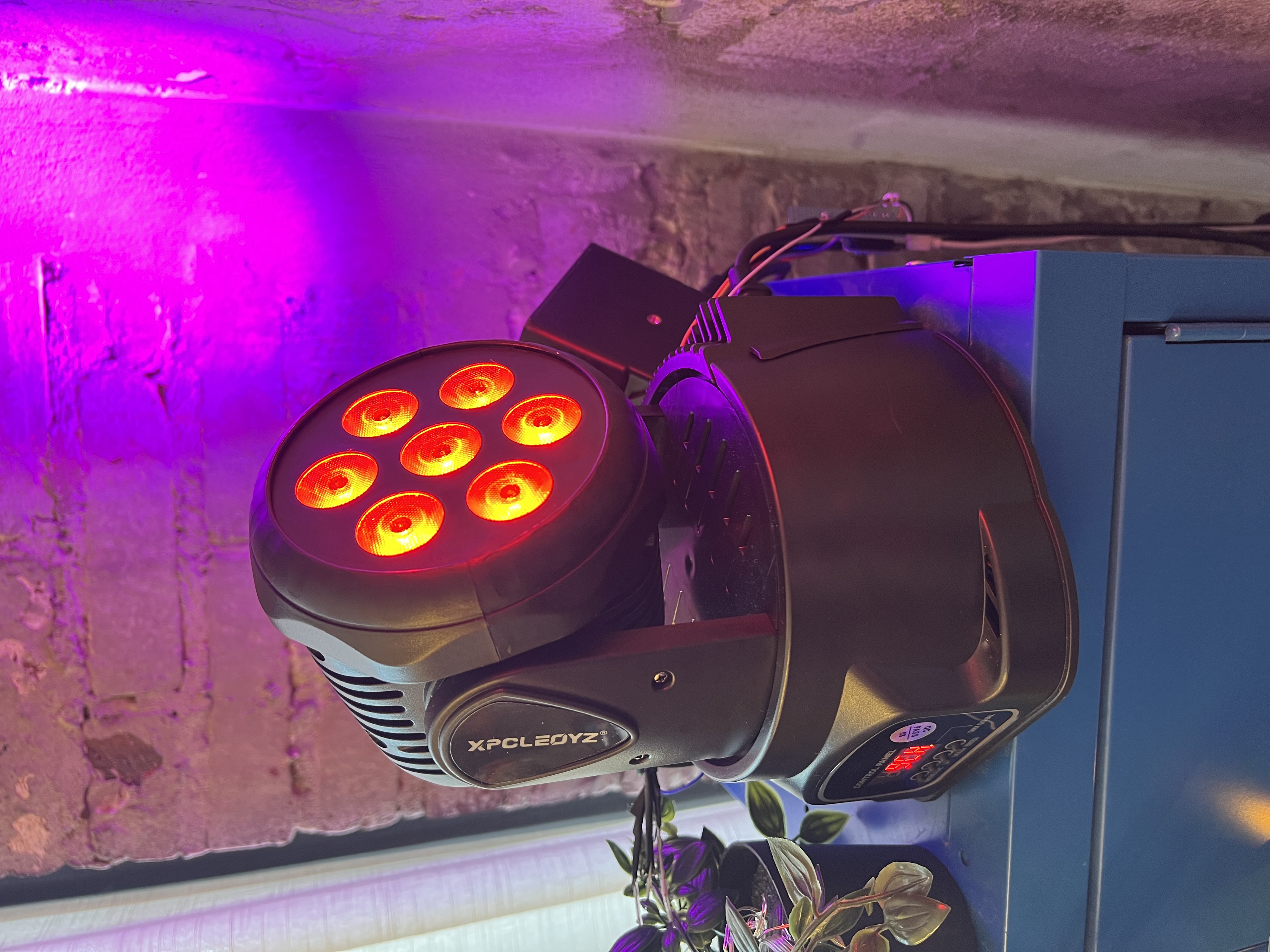
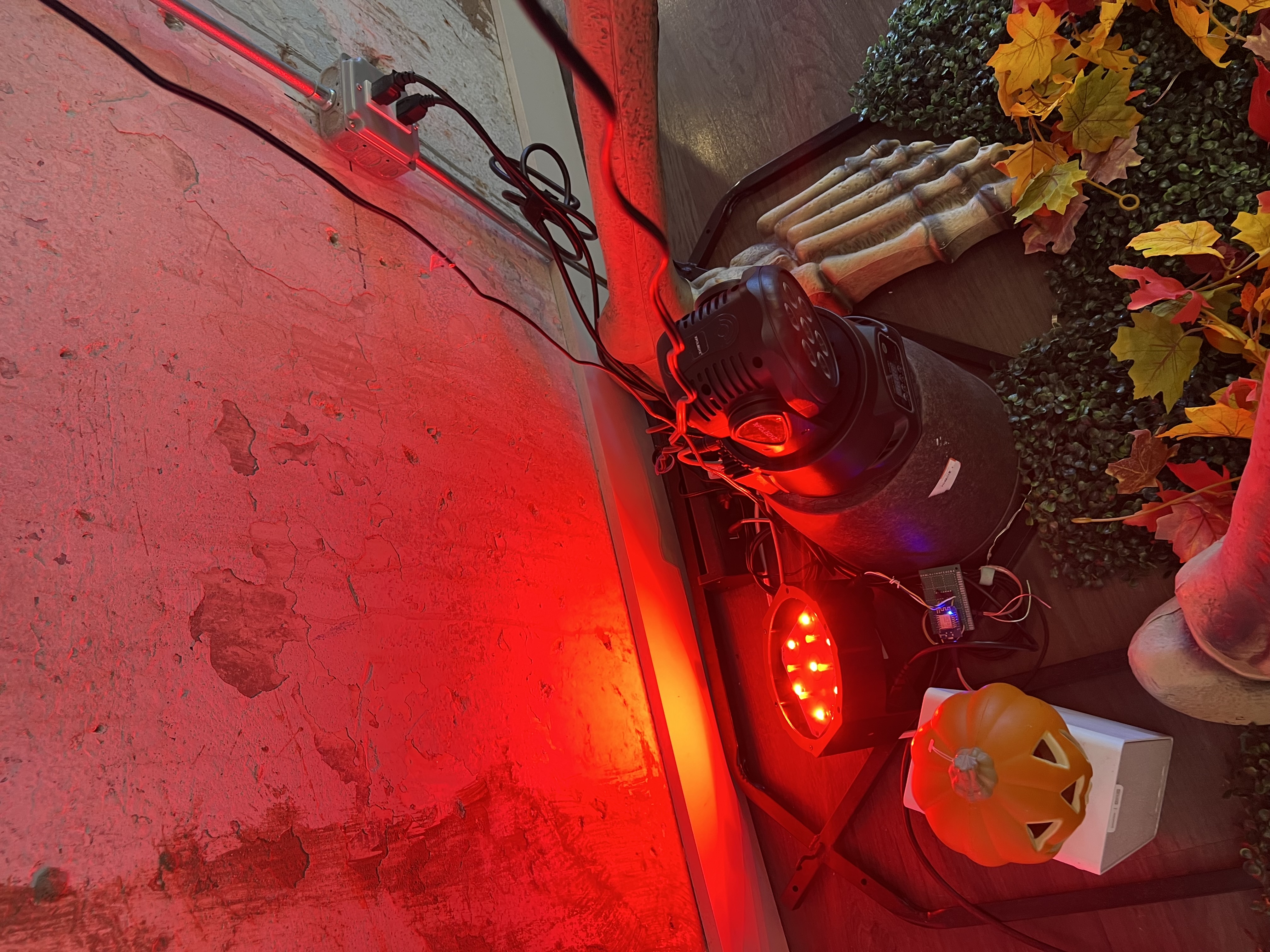
Lights in the setup that used physical DMX included...
Movers
The mirror ball spotlight
Ceiling washes
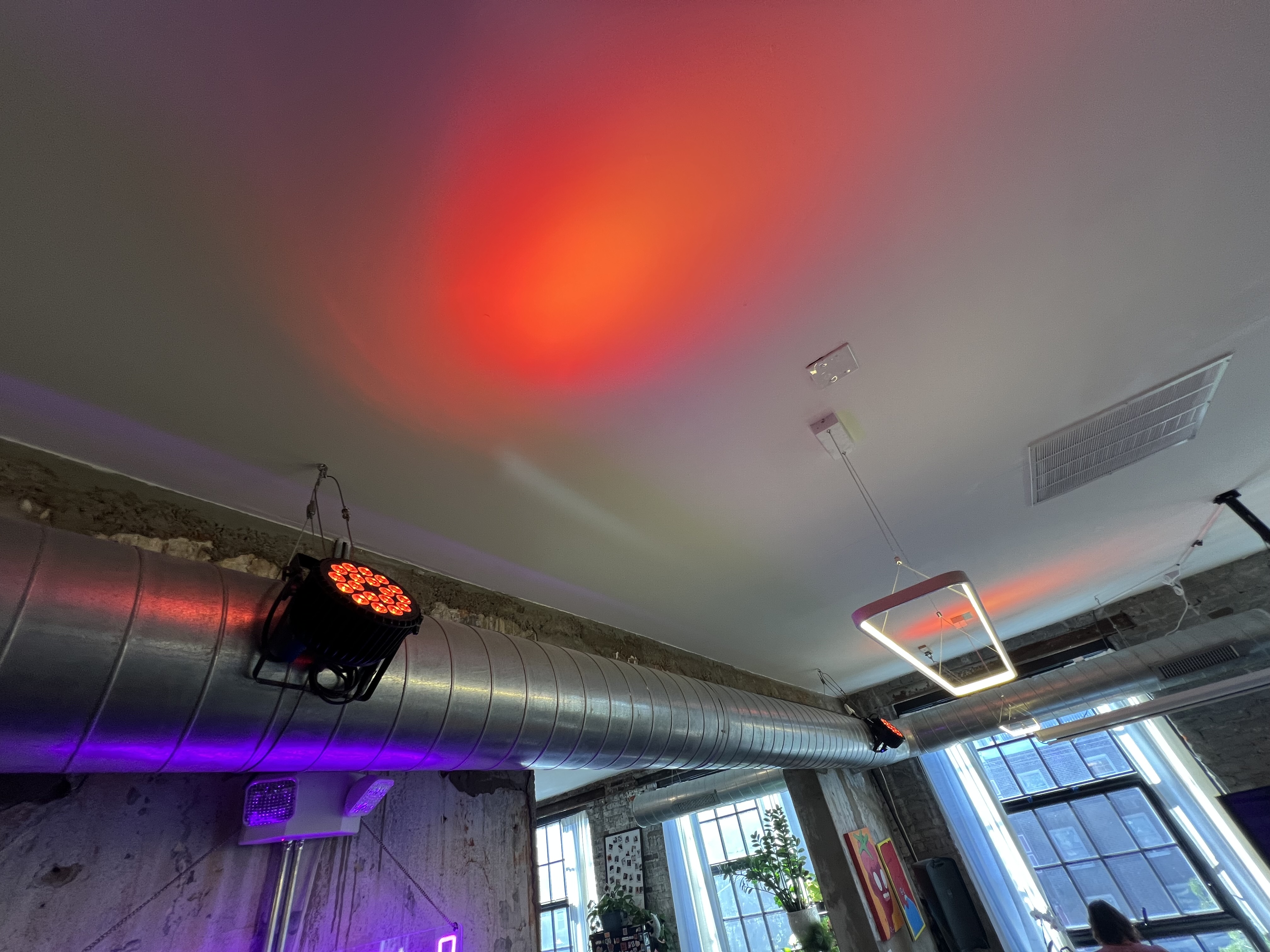
Uplights
Addressable pixel chains
These operate similarly to DMX devices but on a much tinier scale. Rather than a big lighting fixture responding to instructions, individual LEDs on a string can display any color you want.
The technology used as part of the IH20 display was the ubiquitous WS2812, sometimes called Neopixels. Each LED contains a tiny circuit that listens for instructions over its data line, changes its own color when it receives it, then passes the remaining instructions to the next LED on the chain, and repeat. Addressable LED technology has existed in one form or another for a decade or two now, but in 2026, it's surprisingly affordable and accessible; you just need to connect the data line to a microcontroller, load up an Arduino library, and write simple instructions in C.
Lights that used addressable pixels included...
Pixel jars and other fairy lights
Paper lanterns hanging from Brad
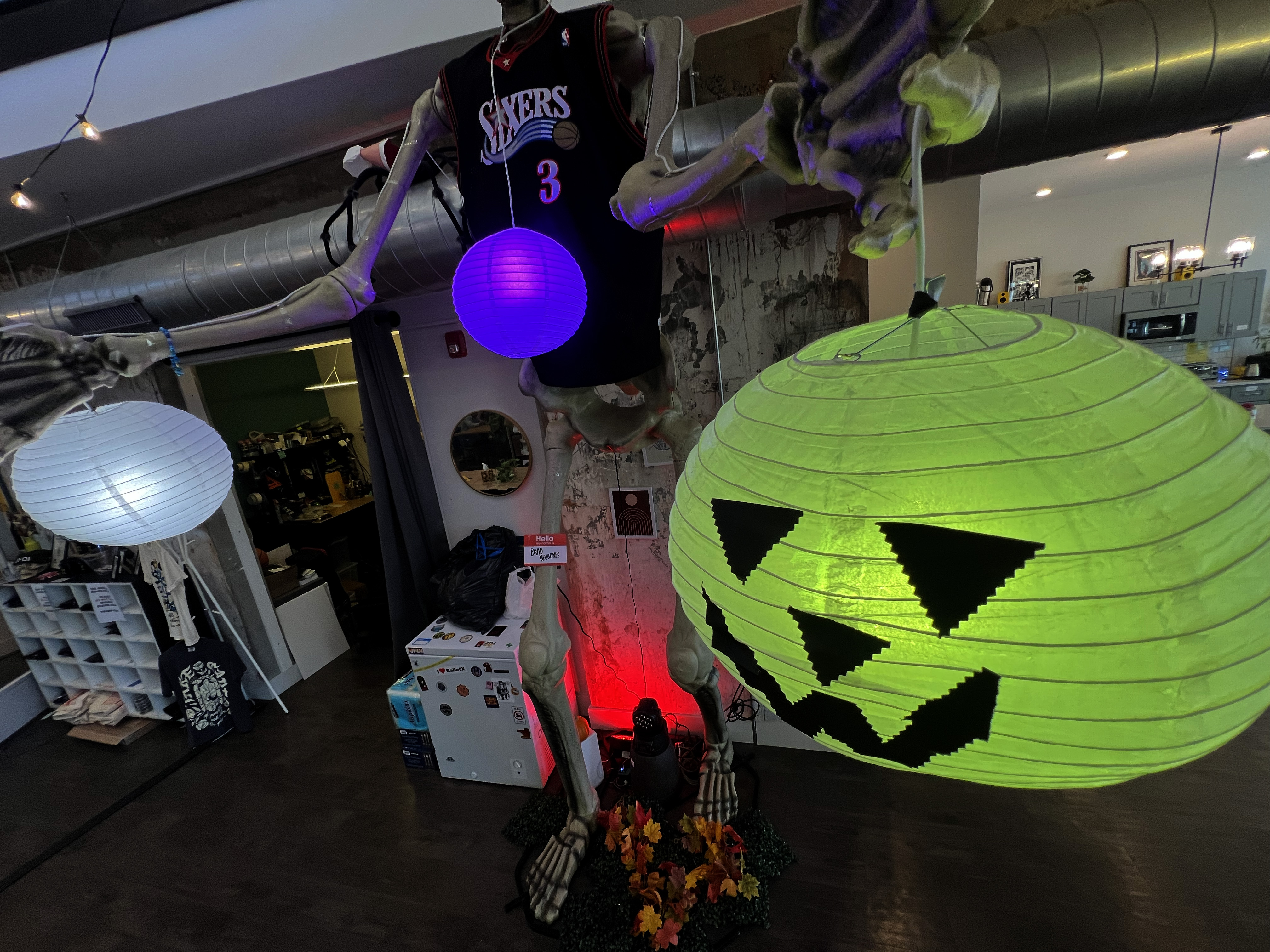
The strip lights behind the lost & found shelf
Commonalities
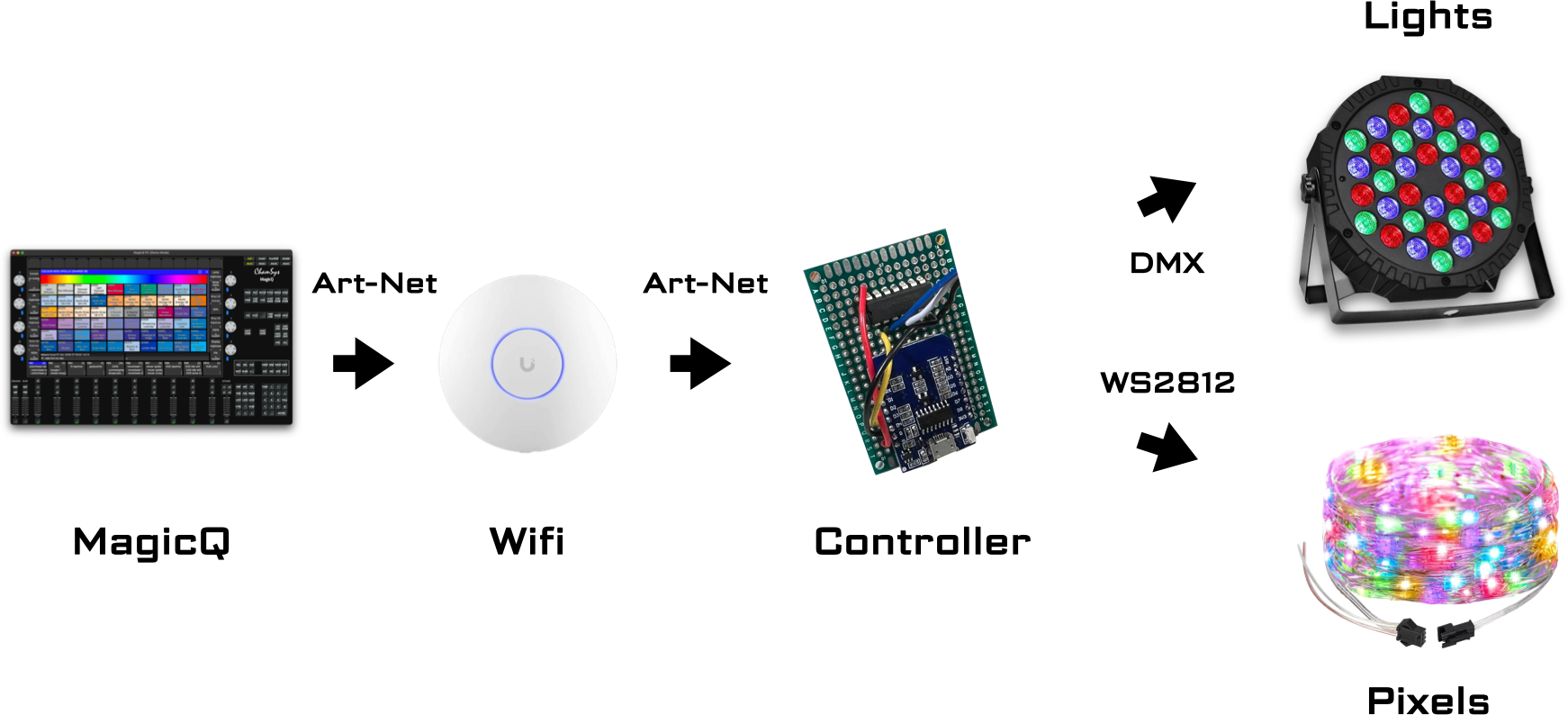
Both of these methods received instructions using a protocol called Art-Net, which is basically DMX over IP. Each packet is the equivalent of a DMX frame (512 bytes) plus a few extra header bytes at the beginning.
At the top of the chain was my laptop running software called MagicQ. This software is originally designed for high-end lighting consoles, but MagicQ is generous enough to allow an almost-fully-functional "demo" version of the software on any machine.
Above: Running a MagicQ test during an after-hours event
The learning curve on MagicQ is very steep and I chose to use it primarily because I've been gaining familiarity with it over the past couple of decades. If you'd like to explore something like this, I'd recommend the much more user-friendly Luminair!
I originally wrote two separate versions of the firmware, one for DMX and one for pixels. But as I gradually built out the setup, it became surprisingly common to have a DMX controller right next to a pixel controller. Not only was this redundant, but I was rapidly running out of components. It took only a small amount of experimentation to discover that I could basically copy the DMX-sending code and paste it into the pixel-sending firmware and it worked just fine.
Above: whynotboth dot gif
Signal flow
This is a bit complicated, so here's a breakdown of how data got from one point to another...
Things I learned
Art-Net over wifi isn't the greatest, especially in a dense RF environment such as a major metropolitan area. Many packets would get lost, leading to periods of awkward latency where lights would occasionally go un-updated for seconds at a time. I partially remedied this by telling MagicQ to send packets constantly instead of just when changes are being made.
That said, I'm really not sure how I could've pulled this off without a wifi-based solution. Being a coworking space, the wifi is naturally going to be quite speedy and robust and available anywhere on the premises. Moreover, the dropouts were quite hard to notice the night of when there was a ton of stuff going on.
Enjoyed this post?
Buy me a coffee!